Perhaps the Oldest Written Prayer
Most Linear A is bookkeeping. But a small group of inscriptions is different — and they are the reason many people suspect the script was used to write a real language, not just to keep accounts.
At mountain-peak sanctuaries and sacred caves across Crete, archaeologists have found stone vessels carrying Linear A that does not behave like a ledger. Nearly the same sequence of signs repeats from one sanctuary to the next — with small regional variations, a sign swapped here, a word added there — across many sites and several centuries. The core stays recognizable.
That repetition is the crucial tell. Inventory entries do not repeat verbatim across centuries and mountain ranges; formulas — dedications, prayers, ritual texts — do, even as they drift in copying. So this fixed sequence reads like a formula. Whether it is a prayer, a dedication, or something else, we do not know.
“Libation table” or “offering table”?
Many of these inscriptions appear on shallow stone bowls with a central depression — the kind of vessel that looks made to receive something. For a long time they were called libation tables, on the assumption that the offering was a poured liquid: wine, oil, honey.
Brent Davis (2026) points out that the archaeology does not actually tell us what — if anything — these vessels held. “Libation” smuggles in an answer we do not have. The more neutral offering table, and offering formula for the text it carries, is the better term. This site follows him.
The shift is small but it matters: it keeps a guess about the ritual out of the name of the object.
Sounding it out
The formula opens with a recurring sequence transliterated a-ta-i-*301-wa-ja, often followed by a second recurring word, ja-sa-sa-ra-me. Five of the signs in that opening have sound-values we can borrow from Linear B, which recycled the same shapes about three centuries later. We can read it aloud.
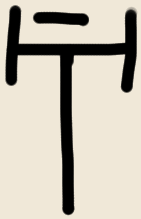 a
a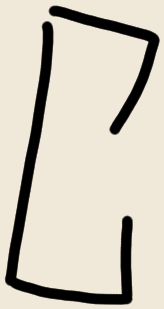 ta
ta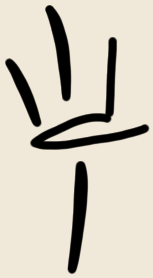 i*301
i*301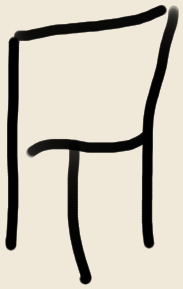 wa
wa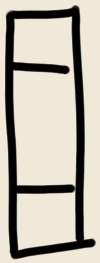 jaja
jaja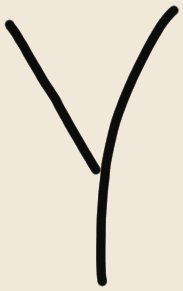 sasa
sasa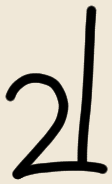 ra
ra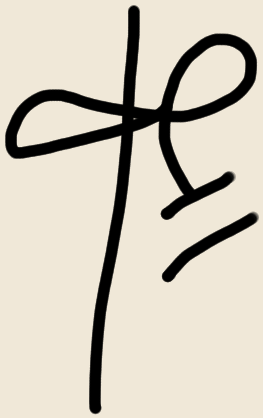 me
meOne sign cannot be read aloud. It is conventionally numbered *301. It appears in essentially no other script, and it has no known sound-value and no known meaning. Scholars do not transliterate it; they number it and move on. So even “sounding it out” is incomplete — there is a hole in the middle of the very first word.
“*301” is a scholarly catalogue number for the sign, not a translation and not a pronunciation. Writing it as a number is the honest move: it marks exactly the place where our knowledge stops.
What scholars have studied: the structure
Because the words cannot be translated, the serious work has gone into the formula’s structure — how its parts are arranged, and how each part behaves across the many copies. Brent Davis (2026), following Yves Duhoux, argues that Minoan word order is verb-initial, and reads the formula on that pattern:
- it opens with a recurring word — a-ta-i-*301-wa-ja — that behaves the way a verb would;
- that is followed by a word that behaves like the name of the dedicant (it varies from object to object, the way a name would);
- then comes a recurring word — ja-sa-sa-ra-me — that behaves like the object of the dedication.
This is a hypothesis about word order and behaviour, inferred from how the pieces pattern across the corpus. It is John Younger’s and Davis’s framework, and it is genuinely useful. But notice what it is not: it does not tell us what any of those words say. “Behaves like a verb” is not the same as “means ‘gives’.”
What it does not say
You will find confident translations of this formula in popular sources. They are not accepted by careful scholars, and this site does not endorse them.
ja-sa-sa-ra-me is sometimes glossed “My Lady,” and i-da-ma-te “Mother of Ida.” Both rest on the etymological method — assigning a meaning because the sounds resemble a word in some known language (Luwian, Greek, and so on). Davis (2026) treats that method as discredited: resemblance is not evidence. The meanings of these words are unknown.
The only Linear A words we can gloss with real confidence come from the accounting tablets, where the arithmetic itself confirms them: ku-ro = “total,” ki-ro = “deficit,” po-to-ku-ro = “grand total.” The formula gives us no such internal check. So the honest statement stands: we can sound it out; we cannot read what it means.