The Accounting
It is tempting to imagine that an undeciphered script must be hiding poems or laws or history. For Linear A, the truth is more humble and more useful: the great majority of the documents that survive are accounts — the day-to-day bookkeeping of the Minoan palaces.
Olive oil, wine, grain, sheep and other livestock, cloth and textiles — counted, sorted, and tallied. The clay was a working surface, not a permanent archive. Most of these records survive only because the buildings that held them burned: the fires that destroyed them also baked the clay hard enough to last three and a half thousand years.
That administrative character matters for everything else on this site. The handful of Linear A words we can claim to understand are exactly the words you would expect a counting-house to need — and we understand them because they behave like accounting terms, not because anyone has cracked the language.
The documents
The administration left more than one kind of object behind, and the differences tell you something about how goods moved.
- Clay tablets. The familiar form: a flat or page-shaped tablet, written on while the clay was still wet, holding a short list of entries. This is where the tally lists and totals appear.
- Sealings. Small lumps of clay pressed onto the fastenings of containers, doors, or documents and then stamped with a seal. They controlled access and recorded who authorised something — the security and authentication layer of the system.
- Roundels. Flat clay discs stamped around the edge with seal impressions and often carrying a sign or two. They appear to have accompanied goods as they changed hands — a kind of receipt or docket travelling with a transaction.
Together these are the apparatus of a redistributive economy: things came in to a central authority and were given out again, and at each step someone needed a record. The script existed to serve that flow.
How an entry works
A typical line on a tablet has a simple, repeating shape. It pairs three things:
- a word — most often a name or a place, sometimes a term we cannot translate;
- a commodity sign — a small picture-like mark (a logogram) standing for the thing being counted, such as a kind of grain or a measure of oil;
- a number — written with its own system of strokes and marks for units, tens, hundreds, and fractions.
Read it as: so-and-so, this commodity, this many. Stack a column of those lines, and you have a ledger. The remarkable thing is that you can follow the arithmetic of such a list — see the quantities add up — long before you can read the words attached to them. That arithmetic is the lever that pried loose the few meanings we trust.
Throughout this site, Linear A words are written only in their conventional Latin transliteration, like ku-ro. These are the sound-values read back from the related, deciphered script Linear B — careful reconstructions, not certainties. We can sound the words out; we still cannot, in most cases, say what they mean.
The words we actually understand
A small number of Linear A words are genuinely understood — and it is no accident that they are all bookkeeping words. We know what they mean not by guessing at the language but by watching where they sit and what the numbers do around them.
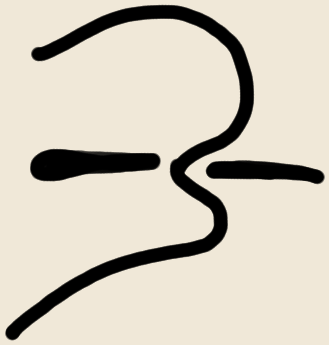 ku
ku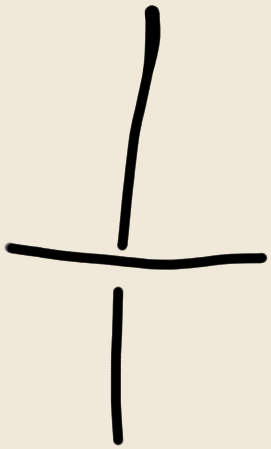 ro
ro- ku-ro — “total.” It appears at the foot of a list, and the figure beside it equals the sum of the entries above. That is precisely the job “total” does on a modern receipt, and it is the single most secure reading in all of Linear A.
- ki-ro — “deficit” or “what is owed.” It marks a shortfall — an amount still outstanding against what was expected — and, like ku-ro, its meaning is fixed by the arithmetic and its position in the lists rather than by guesswork.
- po-to-ku-ro — “grand total.” Built on ku-ro, it appears where a sum of sums is being recorded. It is far rarer than ku-ro, and some scholars hedge over its exact force, but a total-of-totals reading fits its few occurrences.
Notice what these words have in common. None of them required identifying the Minoan language. Each was read from its position in a tally and from the numbers it governs — the combinatorial, context-first method that conservative scholars trust. The flow they imply is the ordinary business of an account: scribes recording what was received or contributed, what was paid out, and what was still owed.
Apart from these accounting terms, the meanings of Linear A words are not known. Many of the entries on a tablet are almost certainly personal names or place names, and several popular “translations” you may meet elsewhere rest on resemblance to other languages — a method most specialists now reject. Where this site does not give a meaning, it is because there isn’t a reliable one to give.
Why this isn’t Linear B
The later, deciphered script Linear B was also used overwhelmingly for administration — its tablets, too, are inventories and rosters rather than literature. But because we can read the Greek behind Linear B, we can see how detailed and specialised its bookkeeping became: tablets tracking named workgroups, ration allotments, military equipment, the offerings owed to particular sanctuaries.
With Linear A we are left with the structure but not the full story. We can see the lists, the commodities, the totals and the deficits; we can watch the sums balance. What we cannot yet do is read the people, places, and terms that fill the lines. The accounts are real and legible as accounts — the language inside them stays out of reach.